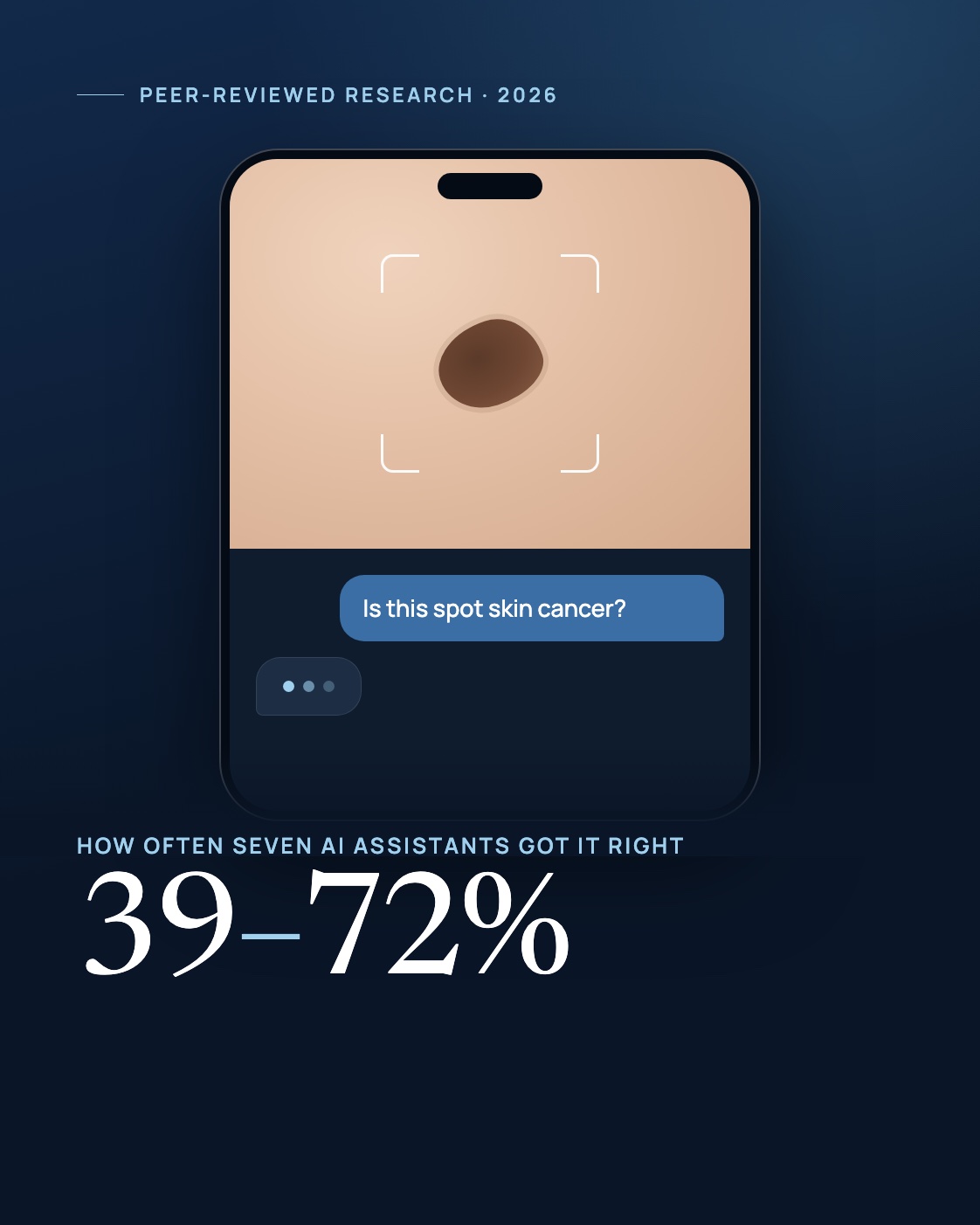
You notice a new spot. You take a photo and ask an AI chatbot what it is. It answers in seconds, and it sounds sure.
A peer-reviewed study set out to measure how often that answer is right. Dr. Roldan co-authored it with colleagues from Muskoka Algonquin Healthcare, NOSM University, and the University of Toronto.1
Not reliably. The best of seven AI assistants named the right diagnosis 72% of the time, and the weakest 39%. Some missed cancers. Others called harmless spots cancer.
The research was published in BMC Medical Informatics and Decision Making in October 2026. This page explains it in plain language.
Why the question matters in Muskoka
People in rural areas spend more time in the sun and live farther from a dermatologist. Both raise the stakes when a skin cancer is missed or found late.
A free chatbot on a phone looks like a shortcut. The study asked whether it is a safe one.
What the study did
The team used photos of 34 skin lesions from a rural practice in Muskoka. Every lesion had been biopsied or removed, so the true diagnosis was known from the pathology report.
- 18 were cancers: 7 melanomas, 6 basal cell carcinomas, and 5 squamous cell carcinomas.
- 16 were not: 5 seborrheic keratoses, 5 actinic keratoses, and 6 Clark nevi (a type of mole).
- Two photos of each: an ordinary close-up and a dermoscopic image, taken through the magnifying scope clinicians use to examine skin.
Seven general-purpose AI chat assistants from OpenAI, Google, and Anthropic were each shown every image five times. Each time, the AI had to name a diagnosis, rate its own confidence, and rate how urgently the spot should be seen.
That produced 2,380 answers, each scored against the pathology result by two independent, blinded reviewers.
The images were de-identified before analysis and had never been posted online. The study was approved by the Research Ethics Board of Laurentian University.
What it found
Across the seven AI models, the correct diagnosis was named between 39.4% and 72.1% of the time. None reached the accuracy, consistency, or safety needed to be used without a clinician.
- The best model was right about seven times in ten. The weakest was right about four times in ten.
- Some models missed cancers. One called a cancer "not cancer" in nearly half of its readings.
- Others raised false alarms. One labelled more than half of the harmless lesions as cancer.
- Free versions did worse. The lower-tier models that are easiest for the public to use were also the least accurate.
The models were generally better at recognising melanoma and basal cell carcinoma than at recognising harmless lesions. Benign spots that resemble cancers were the hardest to call.
Results by model
Two questions matter most. Does the AI catch the cancers, and does it leave the harmless spots alone?
| AI model | Called cancer | Called cancer and urgent |
|---|---|---|
| Claude Opus 4.8 | 88.3% | 77% |
| GPT-5.5 Thinking | 88.9% | 86% |
| Claude Sonnet 4.6 | 82.8% | 72% |
| Gemini 3.1 Pro | 65.0% | 36% |
| Claude Haiku 4.5 | 75.0% | 63% |
| GPT-5.5 Instant | 90.6% | 87% |
| Gemini 3.5 Flash | 52.8% | 40% |
| AI model | Called harmless | Wrongly marked urgent |
|---|---|---|
| Claude Opus 4.8 | 84.4% | 15% |
| GPT-5.5 Thinking | 65.0% | 28% |
| Claude Sonnet 4.6 | 76.9% | 18% |
| Gemini 3.1 Pro | 81.3% | 13% |
| Claude Haiku 4.5 | 68.8% | 22% |
| GPT-5.5 Instant | 45.0% | 35% |
| Gemini 3.5 Flash | 75.0% | 10% |
Higher is better in every column except “wrongly marked urgent,” where lower is better. These are the study's sensitivity, triage safety, specificity, and over-triage figures (Tables 2 and 3 of the paper). Models are listed from highest to lowest overall accuracy.
Claude Opus 4.8 had the highest overall accuracy at 72.1% and the best balance between catching cancers and avoiding false alarms. Even so, it still made clinically important errors.
Several models traded one error for the other. The one that caught the most cancers also raised the most false alarms, and the one least likely to mark a harmless spot as urgent missed the most cancers.
Confident, and still wrong
Each AI was asked how sure it was. Being sure made very little difference.
When a model gave its highest confidence rating, it was still wrong in nearly four of every ten answers. The most confident models were not the most accurate ones.
The answers were not always repeatable, either. Shown the same photo five times, the weaker models often gave different diagnoses.
A calm, certain-sounding answer is easy to believe. In this study, how certain the AI sounded told you almost nothing about whether it was right.
Better images helped
Every model did better with dermoscopic images than with ordinary close-up photos. The odds of a correct diagnosis were about 65% higher.
That is encouraging for clinics, where a dermatoscope is part of a proper skin examination. It also means a phone photo taken at home is the hardest case for these tools, and even the better images were not enough to make any model reliable on its own.
Limits of the study
The authors are clear about what the study cannot show.
- It included 34 lesions from one rural practice, so the estimates are imprecise. Only seven were melanomas.
- The patients were predominantly fair-skinned. Other research has found AI tools are less accurate on darker skin.
- The AI saw only a photo, with no age, history, or location on the body. A clinician would have all three.
- Each AI chose from six possible diagnoses, which is easier than an open question.
- AI models change quickly. The results describe the versions tested between April and June 2026.
What this means for you
The study's conclusion is that these tools may one day help clinicians, under supervision. They are not ready to diagnose, rule out, or triage skin cancer by themselves.
- Don't let a reassuring answer delay a visit. If a spot worries you, have it looked at.
- Don't panic over an alarming answer. Many harmless lesions were flagged as cancer.
- Start with your family doctor or nurse practitioner. They can examine the spot and refer you if it needs a specialist or removal.
Book an appointment with your family doctor or nurse practitioner for a spot that is new, changing in size, shape, or colour, bleeding, or not healing. An AI answer, reassuring or not, is not a substitute for that examination.
Dr. Roldan assesses and removes selected benign skin lesions, cysts, and lipomas. Assessment is arranged by referral from your family doctor or nurse practitioner.
Common questions
Can ChatGPT, Gemini, or Claude diagnose skin cancer from a photo?
Not reliably. In this study the correct diagnosis was named between 39.4% and 72.1% of the time, depending on the model, and none was judged safe to use without a clinician.
Which AI did best?
Claude Opus 4.8 had the highest accuracy (72.1%) and the most repeatable answers, followed by GPT-5.5 Thinking and Claude Sonnet 4.6. The authors stress that even the best model made clinically important errors.
Is it harmful to ask an AI about a mole?
Asking is not the problem. Acting on the answer is. The risk is skipping an appointment because the answer was reassuring, or losing sleep because it was alarming.
What was Dr. Roldan's role in the study?
Dr. Roldan is one of six authors. His listed contributions are resources, investigation, and reviewing and editing the manuscript.
Do I need a referral to have a skin lesion assessed by Dr. Roldan?
Yes. Surgical assessments are by referral from your family doctor or nurse practitioner. The office can explain the next step.
The published paper
The paper is open access under a Creative Commons Attribution 4.0 licence. The study was supported by a grant from the Northern Ontario Academic Medicine Association. This page is a plain-language summary; the figures are taken from the paper and rounded only where the paper rounds them.
This summary is general information and is not a substitute for a medical assessment.
A worrying spot deserves a real examination.
Start with your family doctor or nurse practitioner. If you have a referral or a question about one, the office can help.
Contact the office →